


How the Raven Spoke to Me
Updated: Jan 2
While I was in college, 1977-1982 I spent countless sleepless hours searching through books and photographs on shamanism and mask‑making. Every source seemed to reference another, circling the same ideas. Many described shamans as evil and all masks as forms of heathen worship.
I combed through the entire library at the University of Alaska Fairbanks but still found nothing solid. Exhausted from reading and sketching masks, I eventually fell asleep. Suddenly, the whooshing sound of wings and rushing wind jolted me awake. When I opened my eyes, I saw the ghost of a raven landing near my feet. He was completely white. I tried to sit up, but my body remained asleep.
The raven hopped toward me, beak open, cawing directly at my face. His eyes were wide, and he studied me intensely, tilting his head from side to side, examining me with one eye and then the other.
Then he rose upright, spread his wings toward the sky, and took a deep breath. As he did, the feathers on his chest parted, revealing a face staring straight at me with terrifying eyes. Shock rippled through my body. And then—while my eyes were still open—they vanished.
Immediately, I went to my desk and drew what I had seen, my eyes still wide open.
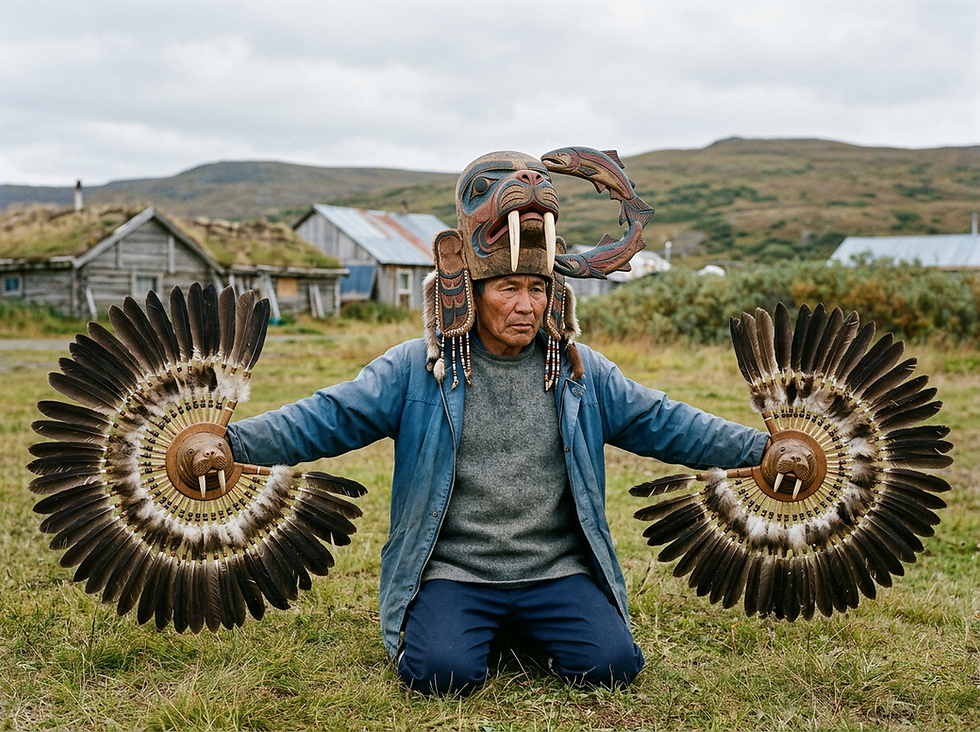
Three days later, in the cold stillness of a -50° ice fog, I found a dead raven beneath the electrical wires. I told myself, “This is a sign.” At the time, I didn’t know anything about the regulations surrounding feathers. Over the years, though, the raven has continued to appear throughout my artwork. I often wondered what message he was trying to give me. Now I understand it as a foreshadowing—an early glimpse of the many forms the raven would take in my creations. The large eyes I saw beneath his feathers eventually became the moving eyes in my work. This style of design has been new to the Yukon–Kuskokwim region since 1996, transforming simple hanging masks into interactive fine art filled with expression and story.
It also signaled the journey I was about to begin. All the learning, challenges, setbacks, hunger, longing, searching—every experience and every piece of wisdom gained—are things I must face with open eyes. And when my body is gone, my spirit must also open itself to its final destiny: to meet Ellam Yua.
Symbolically, the raven was looking upward, as we all must. The Creator is the one I will ultimately face, the one who will remind me of what I did—or failed to do—while I lived. Did I follow Maligtaquyaraq, or did I follow Qaneryaraq, the Word?
Before the first missionaries arrived, our people lived by a system closely aligned with Christian principles. Elders said the teachings mirrored those of the Bible. The Bible is Qaneryaraq—the Word in written form. One late elder, Deacon Mike Angaiak, said the teachings were the same. The being we call Ellam Yua has always referred to the same person: Jesus the Emmanuel. Everything around us was given as a gift to share, just as he shared. The openings in the hands on some masks represent his hands and his guidance over those resources.
Our late elders also warned that the weather would change when humanity gave in to greed—when respect for the land, air, and water was lost. These three things are what every living being on Earth depends on. Selfishness and overindulgence are destroying them. We have become a disposable society built on plastic, fossil fuels, chemicals, toxins, and metals—from diapers and stores to restaurants and cars. So the question becomes: how do I make changes, even small ones? What is my good deed today?
“Wake up,” the raven must have been saying.



Comments